


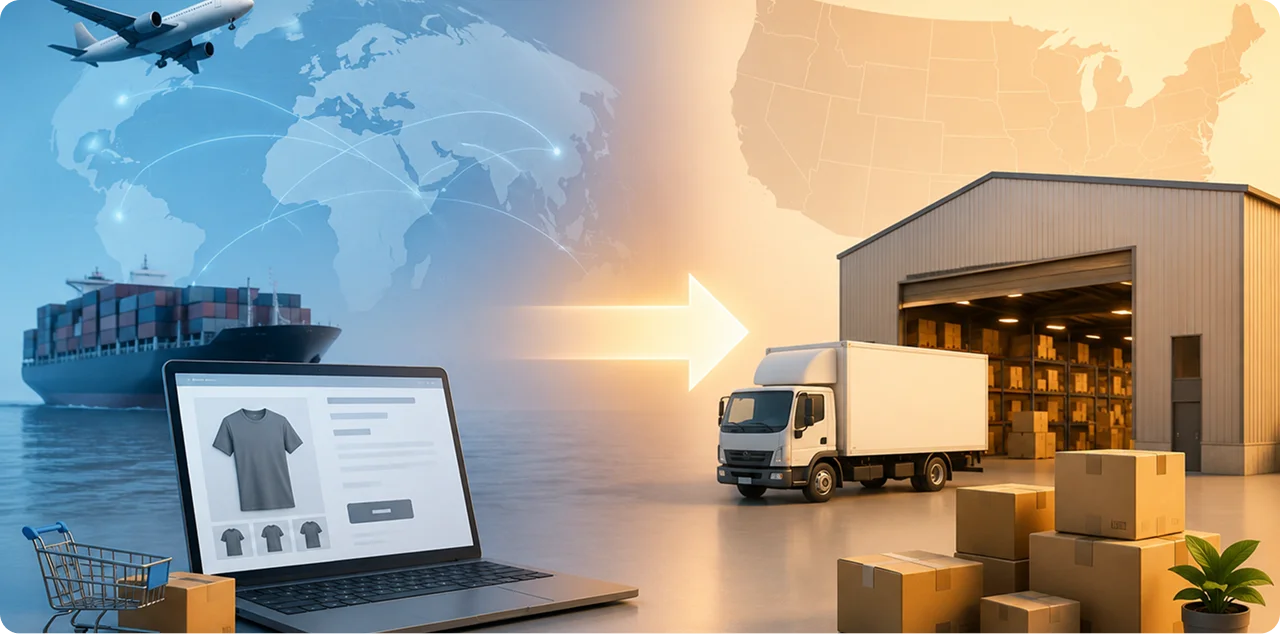
Dropshipping Can Validate the Product, but Domestic Fulfillment Helps Scale the Brand
Dropshipping from China can be a smart way to start an ecommerce business. It keeps upfront investment low, reduces inventory risk, and lets you test whether a product has real demand before you commit to a larger operational setup. For many Shopify brands, dropshipping is not a mistake. It is how the opportunity gets validated
But once your product has traction, the question changes. You are no longer just asking whether people will buy. You are asking whether your fulfillment model can support the size of business you are trying to build.
That question becomes even more important when subscriptions are involved. A one-time customer may tolerate a longer delivery window. A subscription customer expects consistency. They expect the product to arrive on a predictable cadence. They expect tracking to make sense. They expect the next shipment to show up before the subscription starts feeling inconvenient.
At Mountainy, we commonly work with brands that are making this exact transition. They start with dropshipping because it helps them prove demand. Then, as order volume grows and subscriptions become more important, they begin moving proven products into U.S. fulfillment. The transition does not have to happen overnight, and it does not have to be all-or-nothing. Many brands keep their dropshipper in place while shifting their best sellers, subscription SKUs, or most retention-sensitive orders into domestic fulfillment.
The purpose of this article is to help you understand when that move starts to make sense, why subscription brands are especially affected by fulfillment delays, and how a phased approach to U.S. fulfillment can help your brand scale higher without taking unnecessary risk.
Dropshipping Is a Good Validation Model
Dropshipping works well when your biggest priority is testing. If you are still figuring out whether the product converts, whether paid media works, or whether customers want to reorder, it usually does not make sense to over-invest in inventory too early.
That is why dropshipping is so appealing to founders. It allows you to move quickly, test offers, and avoid being stuck with inventory before the product has proven itself. For early-stage brands, that flexibility can be the difference between launching and never getting started.
| Why Brands Start With Dropshipping | Why It Helps Early On |
|---|---|
| Low upfront investment | UniUni is a ground service; cross-country shipments can have fewer scans between handoffs. |
| Lower operational burden | Regional carriers lack USPS-level access to PO Boxes and apartment building mailrooms. |
| Fast product testing | The checkout promise didn't match the carrier's actual speed. |
| Reduced inventory risk | You are not left holding large quantities of product if the offer does not work. |
The issue is not that dropshipping is bad. The issue is that dropshipping is usually built for validation, not long-term scale. Once the product has legs, the same model that helped you start can begin creating friction that limits how far the business can grow.
The Fulfillment Inflection Point
Most brands reach a point where fulfillment stops being a background cost and starts becoming a growth constraint. We think of this as the fulfillment inflection point.
The fulfillment inflection point is the moment when your product has proven demand, but your current fulfillment model starts limiting customer experience, retention, payment health, or scale.
In the early days, slower shipping may be manageable. You may be able to manually answer customer emails, smooth over tracking concerns, or absorb the occasional refund. But as volume increases, those same issues compound. More orders mean more delayed shipments, more support tickets, more refund requests, and more customers wondering where their order is.
Shopify notes that clear delivery dates can help customers know when to expect orders, reduce questions about timing, and give customers more confidence at checkout.1 That matters for any ecommerce brand, but it matters even more for subscriptions because timing is part of the product experience.
| Before the Inflection Point | After the Inflection Point |
|---|---|
| You are testing whether the product sells. | You are trying to scale proven demand. |
| The main goal is reducing upfront risk. | The main goal is building reliability. |
| Long shipping times may be acceptable. | Long shipping times start affecting retention and support. |
| Fulfillment is mostly a cost decision. | Fulfillment becomes growth infrastructure. |
The question to ask is simple: Can your current fulfillment model support the next stage of your business? If the answer is no, it is time to start planning the move to domestic fulfillment.
Why Subscriptions Make Fulfillment More Decisive
Subscriptions raise the stakes because the customer is not just buying once. They are entering an ongoing relationship with your brand.
That relationship depends on consistency. If a subscriber receives their order late, they may run out of product. If the next charge happens before the previous shipment arrives, they may feel like the subscription is out of sync. If tracking is unclear, they may contact support, request a refund, or cancel before the product even gets there.
This is where long international shipping windows become especially challenging. The problem is not only that delivery takes longer. The problem is that subscription programs depend on timing, and timing is harder to control when fulfillment is happening overseas.
| Subscription Need | Why Domestic Fulfillment Helps |
|---|---|
| Predictable delivery cadence | Products are more likely to arrive within a reliable window. |
| Lower cancellation risk | Customers are less likely to cancel because of late or confusing shipments. |
| Fewer support tickets | Faster, clearer tracking reduces “Where is my order?” conversations. |
| Better customer trust | Consistent delivery makes the subscription feel dependable. |
| Cleaner operations | Domestic inventory makes it easier to manage reships, replacements, bundles, and timing. |
Subscription platforms like Loop help brands manage the front end of the subscription experience, including customer portals, dunning, cancellation flows, analytics, and retention tools. Mountainy’s partnership with Loop is built around the idea that subscription growth works best when recurring revenue and fulfillment stay aligned
The software matters. The fulfillment matters too. A strong subscription brand needs both.
The Hidden Cost of Staying in Dropshipping Too Long
Dropshipping often looks cheaper on a per-order basis. In many cases, it is. But once your volume grows, the true cost is not just the supplier cost or shipping cost. The true cost includes everything that happens when the delivery experience starts hurting the business.
Those costs show up in support tickets, refunds, chargebacks, negative reviews, churn, and lost customer trust. They also show up in founder time. If your team is spending hours every week dealing with tracking questions and delayed-order complaints, fulfillment is already costing you more than it appears.
Consumer expectations are also changing. Pitney Bowes reported that U.S. consumers’ definition of “fast shipping” stabilized around an average of 3.1 days for non-grocery categories in 2024.3 Your brand does not need to promise unrealistic shipping speeds, but customers do expect clear, reasonable, and dependable delivery.
Payment risk is another important factor. Stripe explains that ecommerce chargebacks can happen when an item is not received, when there are shipping or logistics issues, or when customers feel the business is not resolving the problem quickly enough.4 Stripe also notes that high chargeback activity can lead to financial losses, operational costs, higher processing fees, and in extreme cases the loss of payment processing services.4
At small volumes, these issues may be manageable. At scale, they become dangerous. A 1% problem at 300 orders per month is very different from a 1% problem at 30,000 orders per month.
| Hidden Cost | What It Can Do to the Business |
|---|---|
| Support volume | Pulls the team away from growth work. |
| Refunds and reships | Reduces the margin advantage of cheaper fulfillment. |
| Chargebacks | Creates payment-processing risk as order volume increases. |
| Churn | Lowers subscriber lifetime value. |
| Bad reviews | Damages trust before new customers even buy. |
| Operational distraction | Keeps the founder focused on problems instead of scale. |
This is why we encourage brands to look beyond the visible cost of each shipment. The better question is: What is the current fulfillment model costing the business in lost retention, support time, payment risk, and growth capacity?
The software matters. The fulfillment matters too. A strong subscription brand needs both.
Domestic Fulfillment Is a Scale Decision
The biggest reason to move into U.S. fulfillment is not simply that shipping gets faster. The bigger reason is that your business can scale higher when fulfillment is more reliable.
If your product has real demand, you need an operating model that can support more customers, more orders, more renewals, and more complexity. Domestic fulfillment gives you more control over inventory, packaging, tracking, reships, replacements, bundles, inserts, and customer communication.
That control matters because scaling a subscription brand is not just about acquiring more customers. It is about keeping them. Every delayed shipment creates a reason for a subscriber to question the relationship. Every on-time delivery reinforces the habi
| Growth Area | How U.S. Fulfillment Supports It |
|---|---|
| Subscriber retention | More reliable delivery helps customers stay in the subscription habit. |
| Customer experience | Shorter delivery windows and better tracking build confidence. |
| Payment health | Fewer delivery-related complaints can reduce preventable disputes. |
| Brand experience | Better packaging, inserts, and unboxing make the brand feel more established. |
| Operational control | Inventory, reporting, and fulfillment rules become easier to manage. |
| Offer flexibility | Bundles, gifts, kits, and retention campaigns become easier to execute. |
At Mountainy, we help Shopify brands scale through 3PL fulfillment. Our fulfillment capabilities include inventory management, order fulfillment, lot tracking, rate shopping, automation rules, bundling and kitting, real-time data access, and detailed reporting.5 For subscription brands, those capabilities are not just operational features. They are part of the infrastructure that allows the business to grow with fewer fulfillment-related constraints.
If you believe your brand has the opportunity to scale, fulfillment cannot stay an afterthought. It has to support the business you are trying to build.
The Move Does Not Have to Be All or Nothing
One of the biggest concerns founders have is inventory risk. That concern is valid. Moving to U.S. fulfillment does not mean you need to immediately abandon your dropshipper, move every SKU, or buy more inventory than the business can support.
In fact, many of the best transitions are phased.
A brand might start by stocking its best-selling SKU domestically. Another brand might move only subscription inventory into U.S. fulfillment first. Another might use domestic fulfillment for high-volume products while keeping the dropshipper active for testing new SKUs, overflow, or backup.
This is very common, and it is often the right way to approach the transition. The dropshipper can stay in place while the brand builds domestic inventory. If U.S. inventory runs out, the dropshipper can still serve as a fallback. That flexibility makes the move less risky and more founder-friendly.
| Phased Transition Option | When It Makes Sense |
|---|---|
| Move best sellers first | When a few SKUs drive most of your volume. |
| Move subscription SKUs first | When recurring customers are most sensitive to delivery timing. |
| Keep dropshipping as overflow | When you want a backup plan during inventory ramp-up. |
| Use dropshipping for testing | When you still want to test new products before stocking them domestically. |
| Expand domestic inventory over time | When demand becomes more predictable and cash flow supports larger buys. |
The goal is not to replace everything overnight. The goal is to move the parts of the business that are already proven into a fulfillment model that can support greater scale.
When You Should Start Considering the Switch
There is no single order count that applies to every brand. The right time depends on your product, margins, subscription mix, customer expectations, and growth goals. But there are clear signals that it may be time to start planning the transition.
| Signal | What it usually means |
|---|---|
| You have consistent order volume | The product has moved beyond early testing. |
| Subscriptions are becoming a meaningful part of revenue | Timing and reliability are now tied directly to retention. |
| Customers are asking about shipping more often | Delays are becoming a support burden. |
| Refunds or chargebacks are increasing | Fulfillment is beginning to create financial risk. |
| Paid media is working | You need operations that protect LTV and support scale. |
| You believe the brand can get much bigger | Your fulfillment model needs to match your growth ambition. |
For many founders, the clearest sign is not a spreadsheet metric. It is the feeling that the brand has outgrown the operating model that got it started. The product is working. The offer is working. Customers are buying. But fulfillment is starting to create drag.
That is the moment to start building the next stage.
What We Have Seen at Mountainy
We have seen brands make this transition successfully when they already have demand and need a fulfillment model that can support a bigger business.
One brand we worked with was doing approximately 7,000 orders per month through dropshipping. The product had traction, but the fulfillment model was not built for the subscription scale the brand wanted to reach. After moving into U.S. fulfillment, the brand was able to scale its subscription program to 50,000+ subscribers.
That does not mean fulfillment was the only reason the brand grew. Product, offer, acquisition, retention, and execution all matter. But domestic fulfillment helped remove a major constraint. It gave the brand a stronger operational foundation for the scale it was pursuing.
| Before the Move | After the Move |
|---|---|
| Around 7,000 monthly orders through dropshipping. | 50,000+ subscribers supported by domestic fulfillment. |
| Fulfillment model optimized for validation and low upfront risk. | Fulfillment model better aligned with scale and retention. |
| Longer delivery windows created operational pressure. | U.S. fulfillment supported a more dependable customer experience. |
That is the core lesson. Dropshipping can help prove the opportunity. Domestic fulfillment can help you capitalize on it.
How Mountainy Helps Brands Make the Transition
Mountainy helps Shopify brands move from early fulfillment models into scalable U.S. fulfillment without forcing an all-or-nothing transition.
We understand that founders do not want to take unnecessary inventory risk. We also understand that if your product is working, slow and inconsistent fulfillment can hold the business back. Our role is to help you find the practical middle ground: start with what is proven, keep flexibility where you need it, and build the fulfillment infrastructure required for the next stage of growth.
That may mean moving subscription orders first. It may mean starting with your highest-volume SKU. It may mean keeping your dropshipper active as a backup while domestic inventory ramps up. The right plan depends on your business, but the objective is the same: help your brand deliver a better customer experience while creating room to scale
Mountainy provides Shopify-focused 3PL fulfillment, inventory management, lot tracking, rate shopping, automation rules, bundling and kitting, reporting, and client portal access.5 We also operate from Pennsylvania and Arizona, supporting fast, reliable delivery across most of the United States
If your brand has proven demand and you believe the business can scale, domestic fulfillment is not just an operational upgrade. It is a growth decision.
The Bottom Line: Keep What Helped You Start. Build What Helps You Scale.
Dropshipping may have helped you validate the product. That does not mean you need to abandon it overnight. But once your brand has traction, you should not let the fulfillment model that helped you start become the reason you cannot scale.
The best path is often gradual. Keep the dropshipper where it still makes sense. Move proven products and subscription volume into U.S. fulfillment. Use domestic fulfillment where speed, timing, and customer experience matter most. Expand as demand becomes more predictable.
For Shopify subscription brands, fulfillment is not just a back-end function. It affects retention, support, chargebacks, customer trust, and growth capacity. If your product has real potential, your fulfillment model needs to support that potential.
At Mountainy, we help brands make that move. The goal is simple: keep what worked early, and build what the next stage requires.
